
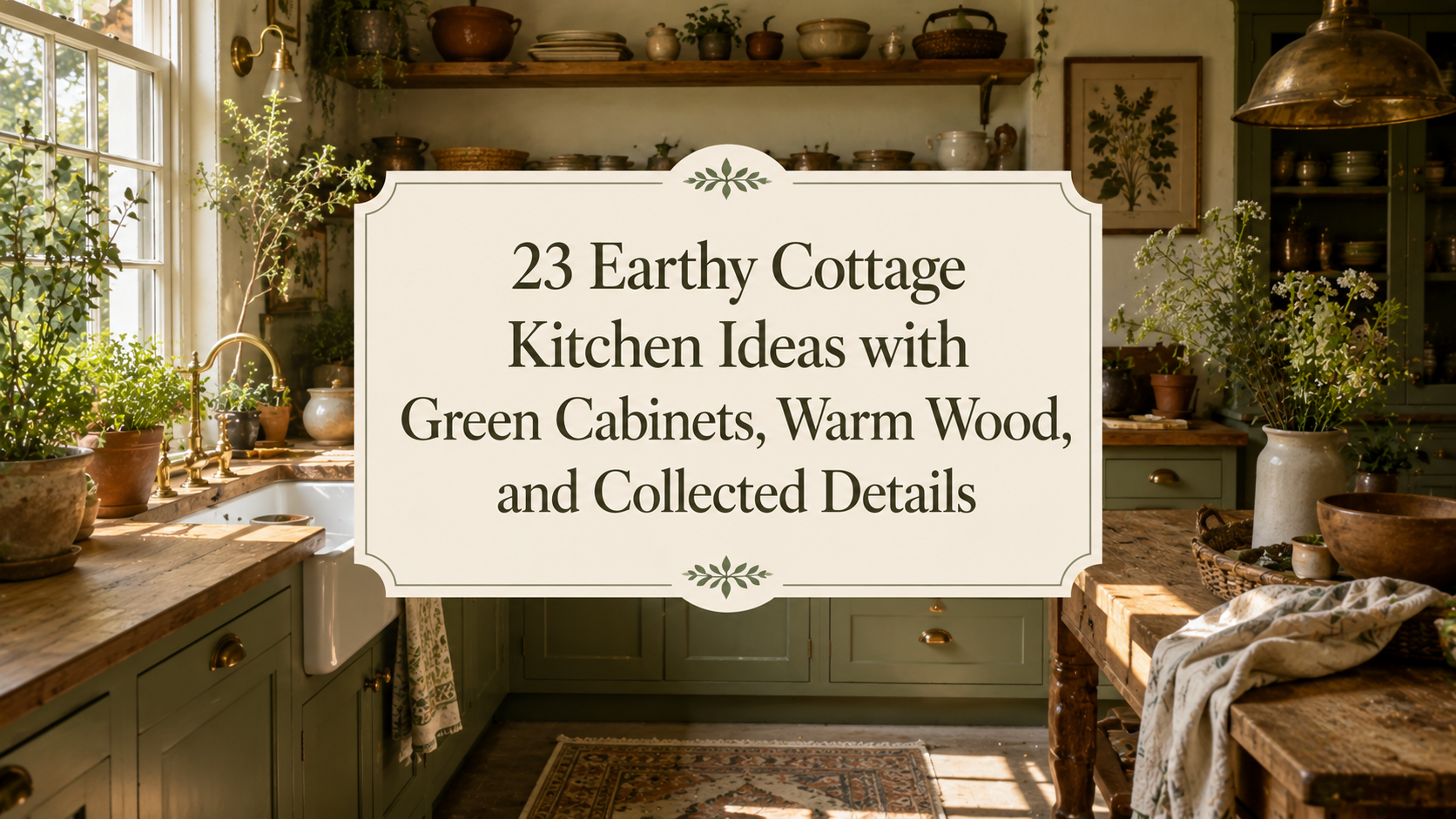
An earthy cottage kitchen combines natural materials, muted color, practical storage, and traditional details that appear to have developed over time. The strongest earthy cottage kitchen ideas rely on warm wood, mineral-inspired greens, aged metals, handmade ceramics, and useful objects kept within reach.
This style works best when decorative elements remain connected to daily function. Open shelves hold dishes that are used regularly, worktables provide preparation space, and textiles soften the room without interfering with cooking. An earthy green cottage kitchen can include both rustic and updated features, provided the materials, colors, and proportions remain visually consistent.

1. Choose Muted Green Cabinets
Muted green cabinetry establishes the earthy palette without making the kitchen feel overly themed. Olive, moss, sage, and gray-green finishes pair naturally with wood counters, cream walls, stone floors, and aged brass hardware.
Use the color across all cabinetry for a more enclosed, traditional effect, or limit it to lower cabinets and an island if the room needs to remain visually lighter. Testing the paint beside existing flooring and counters will help reveal whether the undertone appears warm, cool, or muddy under the kitchen’s actual lighting.
Darker greens suit larger or brighter kitchens, while pale sage is easier to use in compact rooms with limited daylight.

2. Keep Natural Wood Visible
Visible wood grain gives the room warmth and prevents painted surfaces from feeling flat. Oak, pine, walnut, and reclaimed timber can appear on cabinetry, shelving, beams, worktables, or flooring.
The wood does not need to match exactly, but the undertones should relate. Honey-toned boards, orange-red cabinets, and cool gray floors can compete when used together, while several medium brown finishes usually blend more easily.
A restrained mix of wood tones works best when the room already includes patterned tile, textiles, or open displays.

3. Add a Freestanding Worktable
A freestanding table can replace a conventional island and make the kitchen feel less fitted. Choose a sturdy piece with a thick wood top, lower shelf, drawers, or turned legs to add both preparation space and storage.
The table should leave enough clearance for appliance doors and circulation. A slightly worn surface is appropriate, but it still needs to be level, stable, and sealed if it will be used for food preparation.
A movable worktable is more practical than a built-in island when the layout needs flexibility or the room has narrow walkways.

4. Use Open Wood Shelves
Open wood shelves provide storage while keeping useful dishes, jars, bowls, and cookware visible. Thick planks with simple brackets support the cottage character without requiring decorative carving or elaborate trim.
Arrange shelves according to frequency of use rather than color alone. Everyday plates and cups should remain easy to reach, while fragile or rarely used objects can occupy higher levels.
Open shelving makes sense for frequently used items, but closed cabinets remain easier to maintain in kitchens with heavy cooking grease or limited cleaning time.

5. Install Warm Stone or Wood Counters
Countertops with visible texture reinforce the natural character of an earthy cottage kitchen. Honed stone, soapstone, butcher block, and lightly patterned quartz can all work when the finish is quiet rather than glossy.
Wood counters introduce warmth but require regular sealing and more care around sinks. Stone is generally more durable near heat and water, though some varieties can stain or etch.
Combining a durable stone perimeter with a wood worktable provides warmth without placing high-maintenance material in every work zone.

6. Use Aged Brass or Dark Metal Hardware
Cabinet hardware adds small points of contrast across painted and wood surfaces. Aged brass, antique bronze, blackened iron, and dark pewter all suit green cabinetry and natural materials.
Simple knobs, cup pulls, and cabinet latches usually look more convincing than highly ornate hardware. Slight variation between metals can appear collected, but repeating one dominant finish keeps the room from looking disjointed.
Aged brass works well in kitchens that need warmth, while dark iron provides stronger definition against pale cabinetry.

7. Add Handmade-Looking Tile
Tile with irregular edges, subtle glaze variation, or a matte surface introduces texture without relying on bold pattern. Cream, clay, muted green, and soft gray tiles support the earthy palette.
Use handmade-looking tile as a backsplash, behind a range, or on a small feature wall. Highly reflective tile can appear more contemporary, while uneven surfaces catch light in a quieter, less uniform way.
Textured tile is most practical in areas where it can be wiped easily without extending across every wall.

8. Bring In Terracotta Accents
Terracotta adds a dry, mineral warmth that balances green cabinetry and pale walls. It can appear through floor tile, plant pots, serving bowls, lamp bases, or small decorative objects.
The color is strongest when used in limited areas rather than repeated across every surface. Natural terracotta will develop marks and variation over time, which is part of its character.
Terracotta suits dry display areas, while sealed or glazed finishes are easier to maintain near sinks and food preparation zones.

9. Display Useful Ceramics
Ceramic bowls, pitchers, crocks, and canisters can provide storage while contributing color and texture. Cream glazes, brown stoneware, botanical motifs, and hand-painted details fit naturally into the room.
Keep the display connected to use. Crocks can hold utensils, pitchers can store wooden spoons or flowers, and bowls can contain fruit or frequently used ingredients.
Useful ceramics earn their counter space more easily than purely decorative objects in kitchens with limited work surfaces.

10. Add a Vintage-Style Runner
A narrow runner can soften wood or stone flooring and introduce a small amount of pattern. Faded medallions, muted florals, and simple geometric designs work well with green and brown palettes.
Choose a low-pile or washable construction that will not interfere with cabinet doors or trap excessive debris. A non-slip pad is important on hard floors.
A runner is most suitable in long galley layouts or between an island and sink, but it should remain outside areas exposed to frequent grease splatter.

11. Include Botanical or Landscape Art
Small botanical prints, rural landscapes, pressed plant specimens, and still-life paintings add traditional detail to blank wall areas. Mixed wood and brass frames can reinforce the collected appearance.
Artwork should remain away from direct steam, heat, and splashes. Reproductions are often more practical than delicate originals in working kitchens.
Framed art works best on narrow walls where shelving would reduce circulation or create unnecessary visual weight.

12. Use Linen and Cotton Textiles
Linen and cotton bring softness to rooms dominated by cabinetry, tile, and hard flooring. Use them for café curtains, tea towels, tablecloths, seat cushions, or sink skirts.
Muted stripes, checks, and small botanical prints support the style without becoming dominant. Washable fabrics are more suitable than delicate upholstery in areas exposed to food and moisture.
Textiles provide an adaptable way to add color when cabinetry and surfaces need to remain neutral.

13. Add Café Curtains
Café curtains provide privacy while preserving daylight through the upper portion of a window. Linen, cotton checks, and small floral prints work particularly well in earthy cottage kitchen ideas.
Mount them on a slim rod and keep the hem clear of sinks, faucets, and wet counters. A simple gathered panel usually looks more natural than a heavily structured treatment.
Café curtains are most useful for ground-floor windows facing neighboring homes, paths, or streets.

14. Hang Copper Cookware
Copper pans and utensils introduce warm metallic color and visual depth. They can be displayed on a rail, wall hooks, or an overhead rack if the room has enough clearance.
Frequently used cookware should remain near the range, while decorative pieces can occupy higher or less accessible areas. Natural patina can be left in place, though cooking surfaces still require appropriate care.
Wall-mounted copper storage is practical when cabinet space is limited, but overhead racks can feel intrusive in kitchens with low ceilings.

15. Incorporate Woven Storage
Baskets made from willow, rattan, seagrass, or split wood add natural texture while containing produce, linens, recycling, or pantry items. Their uneven surfaces help soften fitted cabinetry.
Use lined baskets for small items and washable containers for foods that may leave residue. Open baskets should remain in dry areas with enough airflow.
Woven storage is useful on open shelves and lower worktables, but sealed bins are better for ingredients vulnerable to moisture or pests.

16. Add Plants Near Natural Light
Herbs, trailing plants, and small potted greenery reinforce the earthy palette and bring life to shelves and windows. Rosemary, thyme, pothos, and ferns can work depending on the available light and humidity.
Avoid crowding the room with plants that block work surfaces or require constant care. Pots with saucers will help protect wood and stone from water marks.
Live plants are suitable where daylight supports them, while cut branches provide a lower-maintenance alternative in darker kitchens.

17. Use a Farmhouse or Apron-Front Sink
An apron-front sink introduces a strong traditional feature and provides a deep basin for large cookware. White fireclay, aged copper, and dark composite finishes can all work within an earthy cottage kitchen.
The sink should be selected according to maintenance needs as well as appearance. Fireclay is substantial and easy to clean, while copper changes color over time and requires a different level of care.
A deep farmhouse sink is practical for frequent cooking, though it may require reinforced cabinetry and altered counter dimensions.

18. Add a Plate Rack
A wall-mounted or built-in plate rack provides visible storage without taking up much depth. It can hold everyday plates, cutting boards, trays, or shallow serving dishes.
Paint the rack to match the cabinetry for a quieter effect, or use natural wood to create contrast. Slots should be sized correctly so plates remain secure.
A plate rack works best near the dining or washing area, where stored items can be reached without crossing the main cooking zone.

19. Mix Old and New Furniture
A kitchen can include modern cabinetry alongside an older table, bench, stool, or hutch. The contrast prevents the room from feeling like a complete period reproduction.
Connect different pieces through repeated materials or colors. A vintage pine table can relate to open shelves, while a painted hutch can repeat the cabinet color.
Mixing furniture styles is most effective when one or two older pieces provide character without obstructing storage or circulation.

20. Choose Warm, Layered Lighting
Layered lighting makes natural materials and muted colors easier to read throughout the day. Combine ceiling fixtures with pendants, wall sconces, and concealed task lighting beneath cabinets.
Fabric shades, opal glass, aged brass, and dark metal fixtures suit the style. Bulbs with excessively cool color temperatures can make wood and green finishes appear flat or gray.
Warm lighting is particularly important in north-facing kitchens or rooms with small windows.

21. Create a Collected Countertop Arrangement
A restrained countertop grouping can make functional objects feel intentional. Combine a crock of utensils, a wood cutting board, a small lamp, and a ceramic bowl rather than scattering unrelated accessories across every surface.
Vary the height and material of the objects while keeping enough clear workspace for cooking.
Trays can help define smaller groupings and make cleaning easier.
Collected details work best when they occupy secondary counter areas rather than the main preparation zone.

22. Add Green Through Tile or Furniture
Green cabinets are not the only way to build an earthy green cottage kitchen. The color can also appear through backsplash tile, a painted hutch, dining chairs, a pantry door, or glazed pottery.
Using green in one substantial feature and repeating it in smaller details creates consistency without making the palette rigid. The exact shades do not need to match, but they should share similar warm or muted undertones.
This approach is suitable when existing cabinetry is in good condition and does not justify repainting or replacement.

23. Allow Space for the Room to Develop
A convincing cottage kitchen should not appear filled all at once. Partially open shelves, a few unframed wall areas, and restrained countertop styling leave room for useful pieces to be added gradually.
Start with durable surfaces and practical storage, then introduce ceramics, linens, artwork, and older furniture as they become available. Repeating wood, green, cream, and aged metal will maintain cohesion even when individual items come from different sources.
A gradual approach is especially important in small kitchens, where too many collected details can reduce workspace and make routine cleaning more difficult.
Leave a Reply